Camp Half-Blood vs Camp Jupiter: A Reader’s Comparison
Camp Half-Blood vs Camp Jupiter compares what a reader actually encounters in each place. Pick the questions you need and choose whether to reveal the Roman setting notes, recommended after The Son of Neptune.
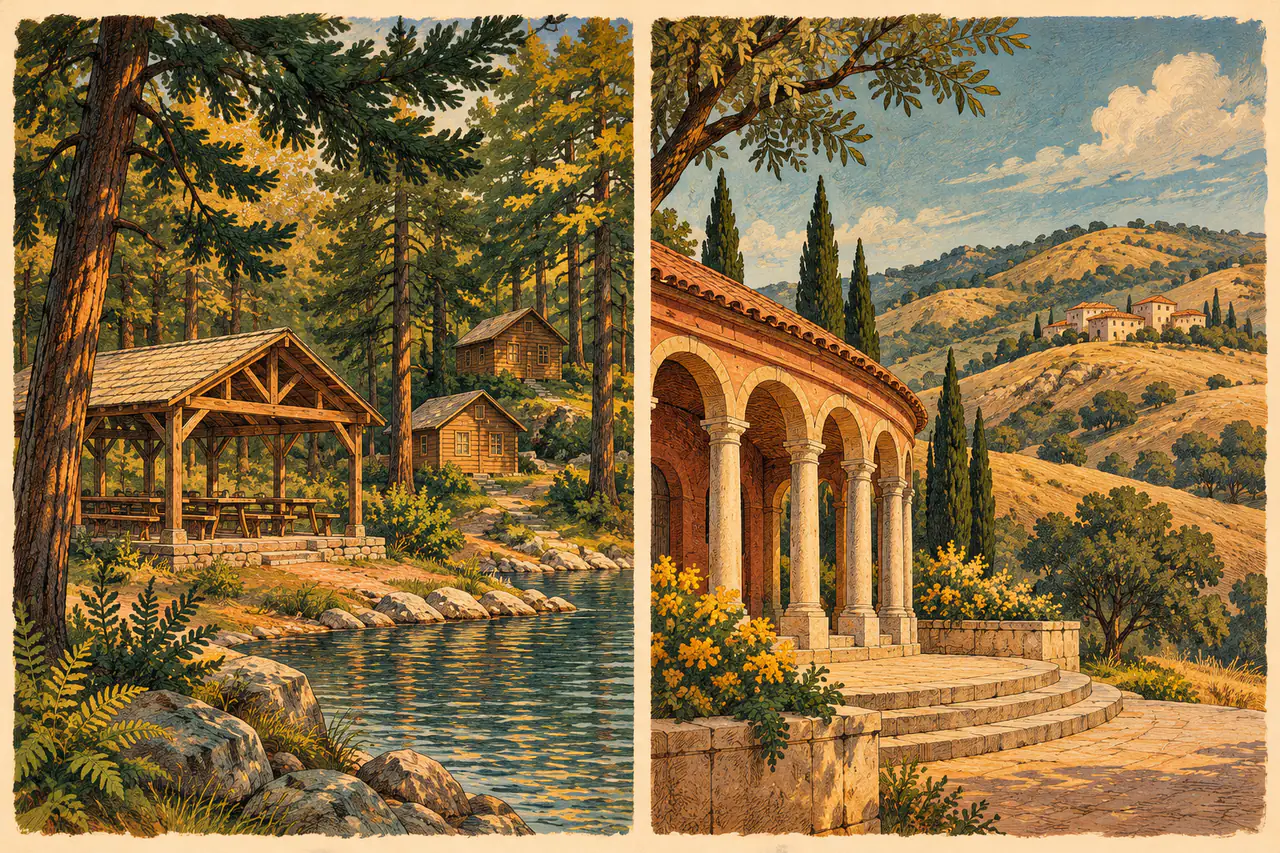
Original fan illustration. The two landscapes are impressions, not a route map or official art.I — II
The comparison desk
How are campers grouped for lodging?
Camp Half-Blood
Cabins are associated with deities; being claimed by a godly parent normally identifies the intended cabin. The publisher orientation describes Hermes’s cabin as a temporary home for campers not yet claimed.
Evidence: Read Riordan · New Camper Orientation
Camp Jupiter
Roman-side notes are covered at this reading boundary. A blank side is not evidence of an absence.
Scope: Greek-side answers only; Roman notes covered.
How to compare the two settings
01Start with the question your chapter raises
Use Camp Half-Blood vs Camp Jupiter when you need a specific answer, not a ranking. Start with housing if a character names their group. Add meals if you are trying to understand where that group gathers. These are different questions, and the tool keeps them in separate rows rather than mixing rooms, roles and customs into one label.
Select up to three prompts. The same prompt stays above both sides, so you can check that each answer is actually comparable. If you already have three, remove the least relevant one; selecting another never silently replaces a choice. The result is a short reading brief, not a test that assigns you to a group.
02Put your reading progress ahead of curiosity
Camp Half-Blood vs Camp Jupiter opens with the second side covered. The author lists The Son of Neptune as book two of The Heroes of Olympus. Use that as the suggested boundary for details about the newer setting. Seeing an adaptation, knowing a character’s name, or having read the original five novels is not the same as finishing that book.
Opening the covered side gives you setting information, not an account of the major turns in the plot. If you want to read without even knowing the names of both locations, leave this page for later. Closing the side hides its answers and removes them from the next download; it does not erase a file you already saved.
03Compare like with like
In Camp Half-Blood vs Camp Jupiter, read the short conclusion after both answers. A building and a group are not always the same kind of thing. The housing row explains that distinction, while the leadership row describes what the cited guides actually identify. A roughly similar function is not a reason to invent an exact counterpart for every title.
The row about staying longer makes a second distinction: a training institution is not necessarily the same thing as a nearby civilian settlement. Check that row when a scene seems to move beyond a place to sleep or practise. The evidence labels tell you which reference was used; they do not turn a fictional illustration into a map.
04Save the version you meant to share
Camp Half-Blood vs Camp Jupiter creates a plain-text file from the visible selection. It records the reading boundary, selected questions, current answers and evidence labels. The covered side does not appear in a restricted file, so you can make a short note for someone at an earlier point without copying unrevealed details.
For a reading group, name the dimension and the book boundary before making a broad claim. Keep the full wording of an uncertain comparison rather than saying one place is better at everything. Your choices live in this page, not in an account. Start a fresh visit to make a separate brief for a different reader.
Before quoting a result
Does this cover the television adaptation?
No. Camp Half-Blood vs Camp Jupiter is a setting reference for the novels. It does not treat the screen version as evidence for a building layout or assume that a season ends at the same point as your reading.
Can the results tell me which place I belong to?
No. Every result answers the same practical question on both sides, from where people eat to what a leadership title refers to. It does not assign a godly parent, predict an outcome, or rate either fictional institution.
Does every detail apply throughout the series?
Not necessarily. The descriptions use the named author maps and publisher orientation for broad setting facts. A particular scene can add exceptions, and this is not an exhaustive list of changing rules, residents or incidents.
Independent fan reference, checked 12 November 2026. Both settings are fictional; the artwork is not a navigation aid.